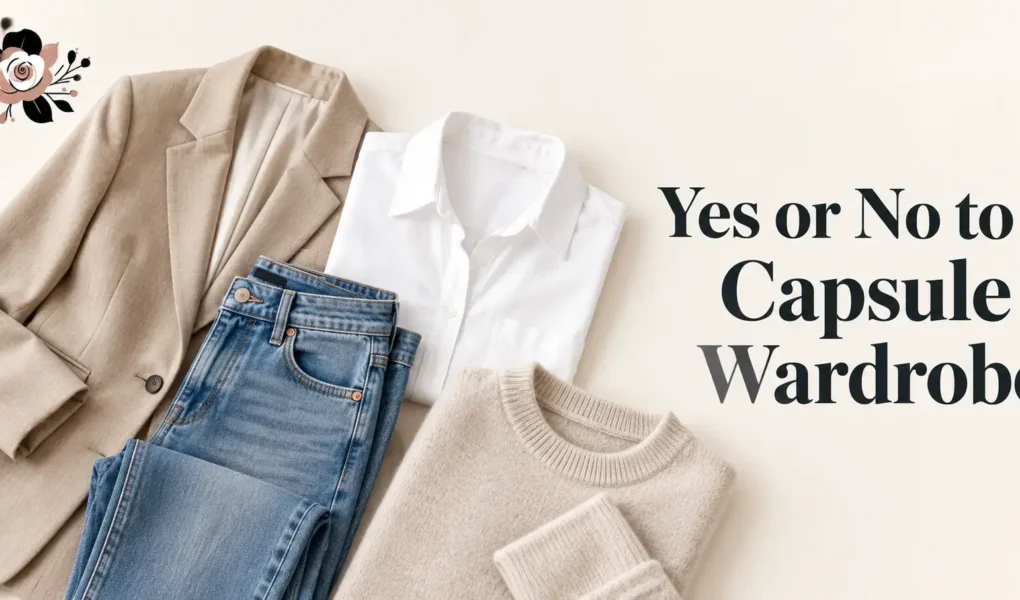
Minimalist influencers swear a capsule wardrobe fixed their mornings, their budgets, and their closets, all at once. Scroll a little further and you’ll find just as many people who tried it, got bored within a month, and quietly went back to buying whatever caught their eye.
The confusion isn’t really about whether a capsule wardrobe can work. It’s about whether it works for your life specifically, which depends a lot more on how you actually dress day to day than any influencer’s closet tour lets on. If you’re weighing this against other style decisions, YesVsNo.net runs the same honest breakdown on plenty of other habits. So is it a yes or no to a capsule wardrobe? Here is what you need to know.
What Is a Capsule Wardrobe?
A capsule wardrobe is a small, deliberately chosen set of clothing, usually somewhere between 10 and 50 pieces, built so that most items mix and match with most other items. The term was coined by London boutique owner Susie Faux in the 1970s and later popularized by Project 333, a challenge that limits a wardrobe to 33 items worn over three months. Good On You’s guide to building a sustainable capsule wardrobe cites a three-week capsule study published in the International Journal of Market Research, where participants reported feeling less stressed and more aware of their consumption habits.
Benefits of a Capsule Wardrobe
The appeal isn’t just aesthetic. Here’s where a capsule wardrobe actually delivers:
It Cuts Down on Decision Fatigue
Fewer pieces means fewer combinations to weigh every morning. When everything in your closet works with everything else, getting dressed stops being a decision you have to think about.
It Can Genuinely Save Money Over Time
Buying fewer, higher-quality pieces that you actually wear on repeat usually costs less per wear than a closet full of trend pieces that get worn once or twice and forgotten.
It Makes Impulse Buying Less Likely
A defined, limited wardrobe gives you a clear filter for new purchases: does this fit what I already have, or is it just something that caught my eye. That filter alone stops a lot of unnecessary spending.
It Reduces Your Footprint on Fast Fashion
Buying less and wearing pieces longer is one of the more direct ways an individual can cut down on textile waste, since the fashion industry’s environmental impact is driven heavily by overproduction and overconsumption.
Concerns and Where a Capsule Wardrobe Falls Short
A capsule wardrobe isn’t the right fit for everyone, though. A few real limitations are worth knowing:
It Can Get Boring Fast
Wearing a rotation of the same 20 to 30 pieces works well for some people and feels repetitive and uninspired for others, especially anyone who treats getting dressed as a form of creative expression rather than a daily chore.
The Upfront Cost Can Be High
Building a capsule around genuinely versatile, durable pieces often means spending more per item than a typical fast fashion haul, which can be a real barrier if you’re working with a tight budget right now rather than planning long term.

So Is It a Yes or No to a Capsule Wardrobe?
The verdict: YES, but with conditions.
A capsule wardrobe is worth building if you’re tired of decision fatigue, want to spend less on clothes long term, or care about cutting down on fast fashion waste. It’s a weaker fit if your job, climate, or sense of personal style depends on a lot of day-to-day variety, or if you genuinely enjoy shopping and dressing as a creative outlet rather than a logistics problem. Start smaller than the influencer guides suggest, 15 to 20 pieces rather than a strict 33, and build up from there based on how it actually feels to wear.
How to Build a Capsule Wardrobe
- Take stock of everything you currently own and sort it into keep, repair, donate or sell, and recycle.
- Pick a neutral color palette, 2 to 3 base colors plus 1 or 2 accent colors, so pieces mix and match easily.
- Start with 15 to 20 pieces across tops, bottoms, layers, and shoes rather than committing to a strict 33-item rule right away.
- Fill any real gaps through secondhand shopping first, then higher-quality new pieces for items you’ll wear constantly, like a daily coat or everyday shoes.
- Revisit the capsule every season, swapping a few pieces in and out rather than rebuilding it from scratch each time.
Who Should Avoid It
- Anyone whose job requires a wide variety of looks, like client-facing roles with strict or varied dress codes
- People who genuinely enjoy shopping and outfit variety as a creative hobby, not just a necessity
- Anyone on a very tight short-term budget, since quality capsule pieces often cost more upfront than fast fashion basics
- People in climates with dramatic seasonal shifts who would need two largely separate capsules anyway
Alternatives
If a full capsule feels like too much commitment right away, a few smaller steps get you partway there.
If you’re a student working with a tighter budget and smaller closet, Yes or No to Capsule Wardrobe for Students covers the same idea scaled down for dorm life and secondhand shopping.
When the real goal is spending less on new clothes rather than owning fewer of them, Yes or No to Repairing Clothes Instead of Replacing Them covers getting more wear out of what you already own.
For anyone where sustainability is the main draw and a full closet overhaul isn’t on the table yet, Yes or No to Paying More for Eco-Friendly Fashion looks at a smaller version of the same trade-off.
Still on the fence? Try our Yes or No Generator for an instant answer, or use the Decision Wheel if you’re torn between going all in or starting small.
Still not sure where you land on this? If it’s a bigger decision than a quick yes or no, The Big Decision Workbook walks you through a full framework to think it through properly.
🧭 Get the Decision Workbook — $19FAQ
How do I create a capsule wardrobe?
Start by sorting your current closet into keep, repair, donate, and recycle, then pick a neutral color palette and build toward 15 to 20 versatile pieces before adding more.
What are the benefits of a capsule wardrobe?
Less decision fatigue when getting dressed, lower cost per wear over time, fewer impulse purchases, and a smaller personal footprint on fast fashion waste.
How many pieces should be in a capsule wardrobe?
There’s no fixed number, but most capsules land between 15 and 50 pieces. Project 333 popularized a strict 33-item version, though starting smaller and adjusting is usually more realistic.
Can a capsule wardrobe actually save money?
Yes, over time. The upfront cost of quality pieces can be higher than fast fashion basics, but a lower cost per wear and far less impulse spending usually make up the difference within a year or two.
What’s the difference between a capsule wardrobe and a minimalist wardrobe?
A capsule wardrobe is a specific method, a small set of interchangeable pieces built around a color palette. Minimalism is a broader mindset about owning less in general, which a capsule wardrobe is just one way to apply to your closet.
Conclusion
A capsule wardrobe earns a genuine yes for most people willing to put in the upfront work, less for the money it saves overnight and more for the decision fatigue and impulse spending it quietly removes from your mornings. Start smaller than the guides suggest, see how it actually feels to live in, and adjust from there.
Still not sure where you land on this? If it’s a bigger decision than a quick yes or no, The Big Decision Workbook walks you through a full framework to think it through properly.
🧭 Get the Decision Workbook — $19